
School System in Bayern
A guide for international families
Last updated: October 2026
This is the long version of the Schools section in Family Life in Ingolstadt. It covers how the Bavarian school system works for children who arrive from abroad, what the Übertritt means in practice, and what to do if you arrive with a teenager. The rules apply across Bayern. It is based on our own experience with two children in Ingolstadt, so check the details with the Schulamt or the school before you decide anything. For schools in and around Ingolstadt, see the school map in the family guide.
Grundschule and the Übertritt
This is where true fun begins. If you haven’t researched this topic yet, but you have a child over 6 or soon to turn 6, grab a drink. It will be a long page.
Grundschule (primary, ages 6–10)
Enrolment is by catchment area: where you live determines your school. You cannot choose freely. This matters for neighbourhood decisions.
If your child is anywhere between 6–10, they will be enrolled in the Grundschule, in a German-speaking class. The kids are expected to learn as they go and with some luck, you may land a teacher who can offer some additional explanation in English. You can opt to defer grades if you don’t want the child(ren) to be under pressure, but that has consequences I’ll explain in the next section.
My younger child was 10 when school started in September and she was enrolled in Year 4. I was told we could try Year 4 until December and if it didn’t go well for her, she could move to Year 3. This is because Year 4 comes with a lot of pressure for children in Bayern. In Bayern, children start school at 6, which made her one of the oldest in the class. On top of that, I didn’t want her to go through the “new kid” experience twice in the space of a few months. So we decided together to go through with the initial set-up.
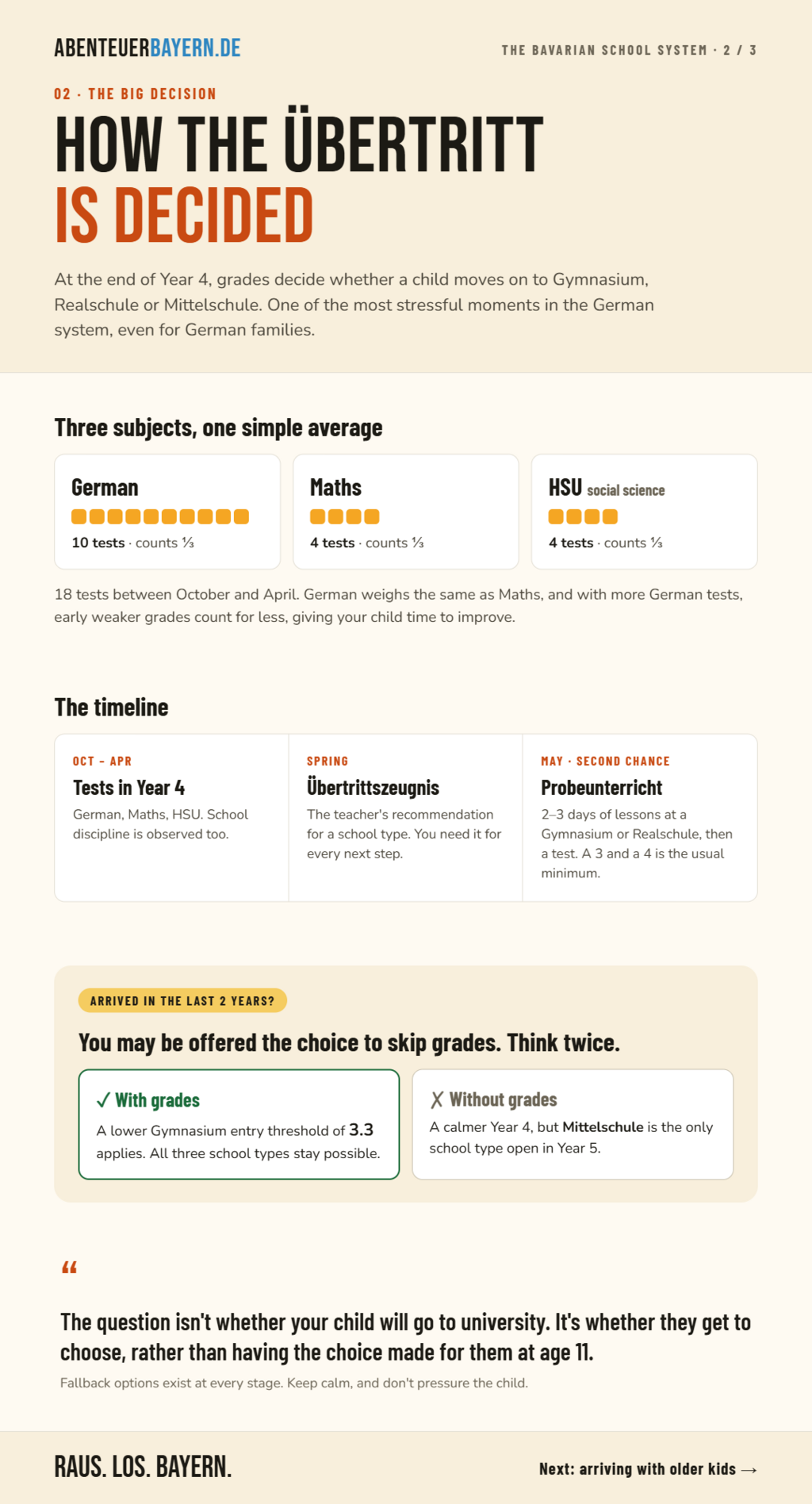
We were also given the option that she wouldn’t receive grades (this applies to children who arrived in Germany within the last two years). However, choosing not to defer is actually the better option: children in that same group who do receive grades benefit from a lower Gymnasium entry threshold of 3.3, compared to the standard required of native speakers or children who have been in the system longer. Deferring grades removes that advantage entirely, leaving Mittelschule as the only available path into Year 5. This will make sense once you read the next section on admission to secondary school (Übertritt).
Admission to secondary school (Übertritt)
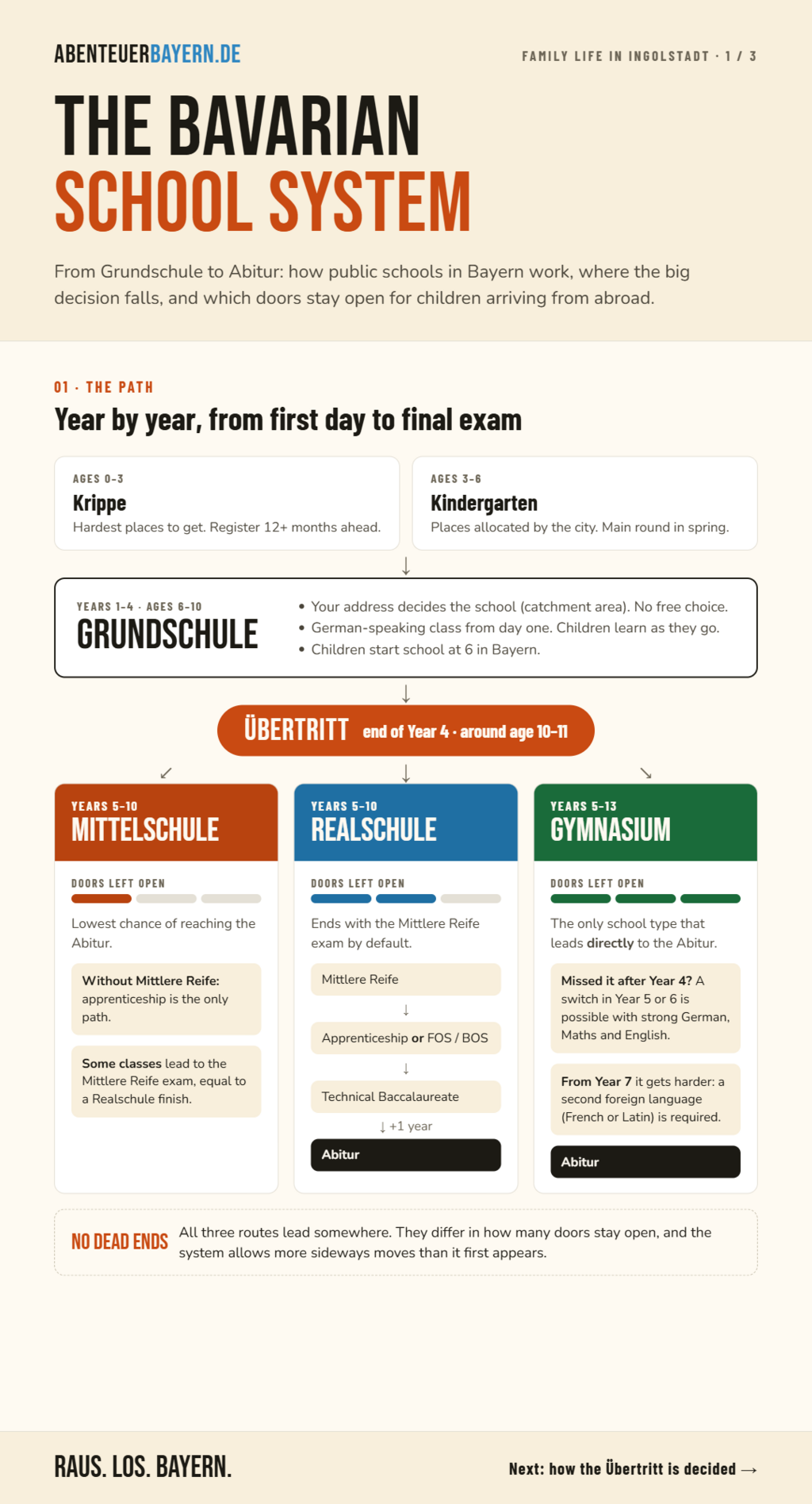
Admission system (Übertritt): After Year 4, children transition to secondary school through a process called the Übertritt, a grading-based assessment that determines whether they go to a Gymnasium, Realschule, or Mittelschule. The decision rests on the simple average of grades across three subjects: German, Maths, and HSU [social science]. This is one of the most stressful moments in the German school system for most families, even German ones, let alone families whose children are just starting to learn German. A child can enjoy a less stressful year if you choose to defer grades, but that means the only type of school available to them in Year 5 is Mittelschule.
If the grades received between October and April are not good enough for a certain type of school, there is still a chance in May. During 2–3 days of teaching (Probenunterricht), children can attend a Gymnasium or a Realschule where they attend lessons. At the end of the period, they sit a test. If they achieve a certain level, they can in principle be enrolled in the respective type of school. The minimum required is a 3 and a 4, though apparently two 4s can also work. In that case, the recommendation is usually for the child to pursue a lower level of schooling. But you don’t get this chance unless you have the admission certificate, the Übertrittszeugnis. This is essentially a teacher’s recommendation for a certain type of school. It is based primarily on grades from 18 tests spread across the period, but also on behavioural observations around school discipline.
The grades are based on 4 tests in HSU, 4 tests in Maths and 10 tests in German. However, the overall grade is a straight average across the three subjects. What this means in practice is that German carries as much weight as Maths, even though there are 10 tests compared to 4. The higher number of tests in German also means those early, weaker grades carry less weight in the final average, which gives your child time to improve steadily from one test to the next.
Our experience
The surprise came in our case from HSU. I hadn’t expected strong results in a subject taught entirely in a language she was just beginning to learn. What I hadn’t accounted for was how limited the test vocabulary was: enough for her to answer most questions correctly, as long as the phrasing was straightforward. In the end, HSU actually lifted her overall grade.
I’m sharing this not to suggest it’s a replicable formula, but because understanding how the system works gave us the confidence to stay calm through it. The outcome was positive for us and it can be for you too, as long as you don’t pressure the kid. The more useful takeaway is that fallback options exist at every stage. Children are also more adaptable than we give them credit for: they pick up the language, read the social dynamics, and find their footing faster than most adults expect. The hardest part is often managing our own anxiety as parents, not theirs. I hope that setting the right expectations from the beginning will make the process more manageable for you.
Why the type of school matters
Disclaimer: this section is only relevant for those looking into the public school system. If you are going for the private one, nothing you’ll read below is applicable.
The honest answer is that it depends on what you want to keep available for your child. All three school types lead somewhere, and none is a dead end. But they differ a lot in how many doors they leave open further down the line.
If you think in terms of access to higher education, the hierarchy is clear: Gymnasium preserves the most options, Realschule preserves some, and Mittelschule (without the Mittlere Reife) closes the university route entirely. That said, the German system has more lateral movement than it appears at first glance, and a child who starts at Realschule can still reach the Baccalaureate (Abitur) with the right path through FOS (Fachoberschule) or BOS (Berufsoberschule).
What I kept coming back to was the question of choice. Not whether my children would necessarily pursue higher education (honestly, for their generation, that’s far from certain). But whether they would have the option to choose, rather than having the choice made for them at age 11. That felt worth fighting for, even if the option ultimately goes unused.
If that framing sounds like you, the Übertritt stops feeling like a pass-or-fail moment and starts feeling like what it actually is: an early sorting mechanism that you can partially influence, and partially work around.
Mittelschule (Year 5 to Year 10): lowest chances of Baccalaureate (Abitur)
Graduating without taking the Mittlere Reife exam at the end of Year 10 leaves the child with few options: an apprenticeship is the only path forward. However, some classes within the Mittelschule do lead to the Mittlere Reife exam, which is equivalent to the Realschule graduation exam.
Realschule (Year 5 to Year 10): medium chances to take the Baccalaureate
This type of school ends by default with the Mittlere Reife exam. Passing this exam means the child can continue either with an apprenticeship or by going to a Fachoberschule (FOS) or Berufsoberschule (BOS), either of which can lead to a Technical Baccalaureate. With an additional year at FOS or BOS, they can sit the full Baccalaureate (Abitur).
Gymnasium (Year 5 to Year 13): highest chances to reach the Baccalaureate
This is the only school type that leads directly to the German Abitur. If your child is interested in this pathway and doesn’t pass the Year 4 assessments, they can still transfer to a Gymnasium in Year 5 or 6, as long as they have strong grades in German, Maths, and English. However, from Year 7 onwards, transfers become much more difficult. At this point, schools begin to specialize their curricula, and students must have working proficiency in a second foreign language (typically French or Latin) to transfer from Realschule to Gymnasium.
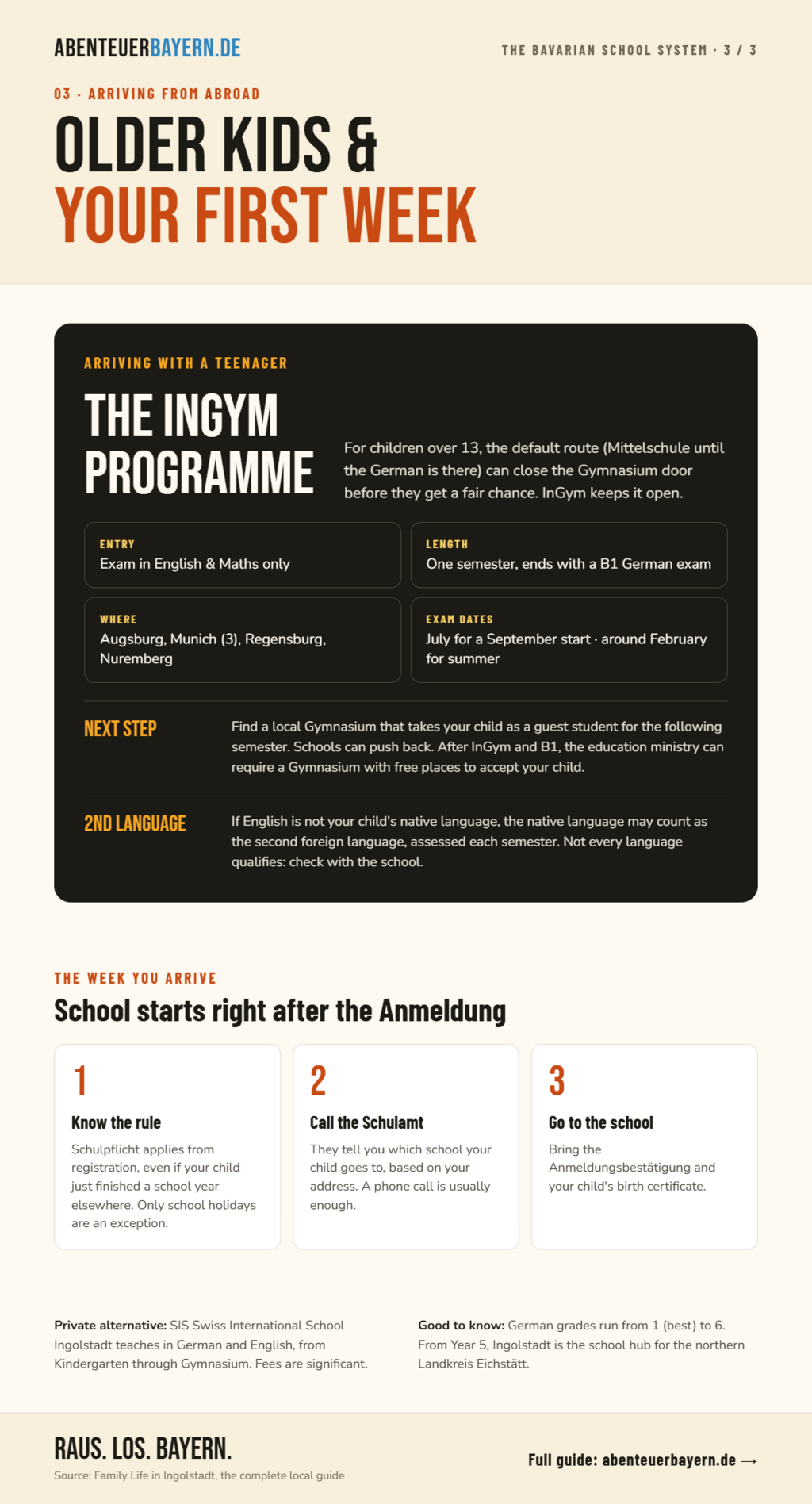
For students whose native language is not English, there is an exception: they may use their native language to satisfy the second-language requirement. A specialized teacher will assess the child in their native language each semester through the end of Gymnasium. This exception exists because English is the first foreign language taught in German schools, so it cannot serve as a second language. However, this option is not available for every language, so you should verify with your child’s school, or ideally with the relevant state education ministry.
The InGym programme for teenagers
For families arriving with a teenager, there is an important additional consideration: if preserving access to higher education matters to you, arriving with a child over 13 adds a lot of complexity. The default pathway the system offers (Mittelschule until German proficiency is established, then placement in Mittelschule or Realschule) effectively closes the Gymnasium route before your child has had a fair chance to demonstrate their capabilities. This was not acceptable for us. We wanted our oldest to have all options available, which is why the InGym programme mattered so much.
The InGym programme is designed specifically for teenagers arriving from abroad with limited or no German. As of 2026, it is only available at certain Gymnasien in a few Bavarian cities. Augsburg is the option most teachers around Ingolstadt recommend, Munich has three, and Regensburg and Nuremberg also offer it. Admission is based solely on an entrance exam in English and Maths. For the winter semester starting in mid-September, the exam typically takes place in July. Munich schools coordinate a joint exam; the others run their own exams independently, so contact each school directly for their specific exam dates. For the summer semester, the exam takes place around February.
The programme lasts one semester and concludes with a B1-level German exam. Maths and English are equally important components, though they should not present a challenge, since applicants are initially evaluated in these areas before admission.
An important step to be aware of: Shortly after enrolment, parents must find a Gymnasium in their local area willing to accept the child as a guest student for the following semester. During this time, the teenager is essentially on probation. Since all schools have a degree of independence, they have the right to push back on new enrolments, so this phase can be challenging. However, once your child has successfully completed the InGym programme and earned B1-level German proficiency, they have effectively proven their readiness for Gymnasium. In such cases, the ministry of education can require a Gymnasium with available capacity to accept them.
I personally went through several discussions and rejections before finally getting to speak to the right person and getting the confirmation that we can enrol the child in one of those Gymnasien as a guest student, without needing to reach out to the ministry of education.
- InGym flyer (PDF, Bavarian Ministry of Education)
- Bavarian Ministry of Education: integration support
- Bavarian state publication (bestellen.bayern.de)
Your first week
What to do the week you arrive: Immediately after the registration of the new address (Anmeldung), your child needs to start attending school. This is a legal obligation of any parent living in Bayern and the only exception is if you arrive during a school holiday. Do not assume that you are exempt from this obligation because the child has finished a school year in another country (even in another German Bundesland). We planned our move right after our kids had finished the school year in our home country and we were taken by surprise by this obligation (Schulverpflichtung). Unless you have already decided for a private school, you’ll need to contact the Schulamt to find out which school you need to enrol your kids in, based on your residence. In my experience there’s no need to visit; a call is enough. Schulamt Ingolstadt. In other Bavarian cities, look for the Schulamt of your district.
Once you have the answer, go to the school with the residence registration confirmation (Anmeldungsbestätigung) and your child’s birth certificate (for European birth certificates that are also in English, you don’t need an apostilled document).
This guide is updated quarterly. If something has changed, is missing, or is wrong, email us at info@abenteuerbayern.de.
Back to the main guide: Family Life in Ingolstadt.